
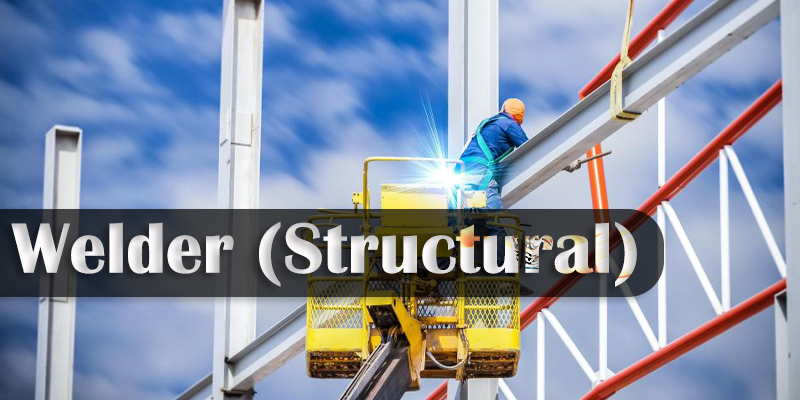
ITI Welder (Structural) Syllabus (English)
Course Overview
- Trade Name: Welder (Structural)
- Duration: 1 Year (2 Semesters)
- NSQF Level: Level 4
- Eligibility: 10th Grade Pass
- Objective: To train candidates in welding techniques for structural steelwork, including arc, MIG, and TIG welding, equipping them for roles as structural welders in construction, bridges, pipelines, or heavy industries, or for self-employment in structural welding and repair services.
- Certification: National Trade Certificate (NTC) by NCVT
Detailed Syllabus
Semester 1
Trade Theory
- Introduction to Structural Welding: Importance in construction, bridges, and pipelines; welder’s role.
- Safety Practices: PPE (welding helmets, gloves, boots), fire safety, working at heights, electric shock prevention.
- Welding Processes: Shielded Metal Arc Welding (SMAW), Gas Welding, electrode types, and filler materials.
- Metallurgy Basics: Properties of structural steel, effects of heat, weld imperfections (cracks, porosity).
- Tools and Equipment: Welding transformers, rectifiers, gas torches, angle grinders; setup and maintenance.
- Structural Components: Beams, columns, trusses; reading structural drawings and weld symbols.
- Engineering Drawing: Weld joint types (butt, fillet, lap), structural blueprints, sectional views.
Trade Practical
- Safety Drills: Using PPE, securing gas cylinders, practicing fall protection, setting up fire extinguishers.
- Arc Welding Practice: Depositing straight beads, welding fillet joints on mild steel plates (6-10 mm).
- Gas Welding: Setting up oxy-acetylene torches, welding mild steel in flat position.
- Cutting Tasks: Using gas cutting torches to cut structural steel sections (angles, channels).
- Joint Preparation: Grinding bevel edges, preparing butt and fillet joints for welding.
- Structural Exercises: Marking and cutting steel plates for beams or columns using templates.
- Project Work: Welding a structural T-joint assembly (e.g., beam-to-column connection) with fillet welds.
Hours: Theory: 160 hours | Practical: 240 hours
Semester 2
Trade Theory
- Advanced Welding Techniques: MIG (Metal Inert Gas), TIG (Tungsten Inert Gas), flux-cored arc welding (FCAW).
- Structural Fabrication: Aligning beams, columns; using jigs, fixtures for large structures.
- Weld Imperfections: Slag inclusion, lack of fusion; causes, prevention, non-destructive testing (visual, dye penetrant).
- Welding Codes and Standards: BIS, AWS D1.1 for structural welding, quality requirements.
- Maintenance: Troubleshooting welding equipment, repairing torches, checking power cables.
- High-Strength Steels: Welding techniques for HSLA (High-Strength Low-Alloy) steels, preheating methods.
- Entrepreneurship: Starting a structural welding business, costing, trends in construction industries.
Trade Practical
- MIG/TIG Welding: Welding structural steel in vertical/horizontal positions, adjusting gas flow.
- FCAW Practice: Welding thick plates (12-20 mm) for heavy structures, ensuring penetration.
- Fabrication Tasks: Assembling a truss or frame using jigs, welding multiple joints (butt, fillet).
- Weld Inspection: Checking welds for defects, performing dye penetrant tests, measuring weld size.
- Maintenance Work: Overhauling welding machines, replacing consumables (nozzles, electrodes).
- High-Strength Welding: Welding HSLA steel plates with preheating, ensuring crack-free joints.
- Project Work: Fabricating and welding a structural component (e.g., bridge girder section) with multiple welds and quality checks.
Hours: Theory: 160 hours | Practical: 240 hours
Additional Components
- Workshop Calculation and Science
- Calculations: Weld bead length, material estimation, electrode consumption.
- Science: Heat-affected zones, thermal conductivity, electrical principles in welding.
- Hours: 80 hours/year
- Engineering Drawing
- Drawings: Structural assemblies, weld symbols, detailed views of beams and columns.
- Hours: 80 hours/year
- Employability Skills
- Communication: Reporting weld quality, coordinating with supervisors, teamwork on sites.
- IT Literacy: Using CAD for structural designs, online welding standards resources.
- Soft Skills: Time management, resume writing, interview preparation.
- Hours: 60 hours/year
Assessment and Certification
- Exams:
- Theory: Written exams per semester (MCQs, descriptive questions).
- Practical: Tasks like welding structural joints, fabricating assemblies, weld inspections.
- Evaluation Criteria: Weld strength, structural alignment, adherence to standards, safety practices.
- Certification: NCVT National Trade Certificate (NTC) upon passing both semesters, globally recognized.
Career Opportunities
- Employment: Structural welder in construction, bridge building, pipelines, or heavy industries.
- Self-Employment: Welding workshop, freelance structural repair services, contract welding for infrastructure.
- Further Studies: Diploma in Welding Technology, certifications in advanced welding (FCAW, coded welding).